
The End of Big Money in Executive Search

Up to 33% fees and a 50% failure rate: executive search is failing health systems
Updated October 29, 2026, with current pricing.
Retained executive search typically costs about one-third of a hire’s first-year cash compensation, plus expenses, and much of the sourcing work is often delegated to junior staff. With median nonprofit hospital margins hovering around 1–2%, that’s a heavy cost. A flat-fee or subscription model with built-in onboarding coaching can lower the cost per search and support the new leader after day one.
The math your board should see
Say you're hiring a hospital CFO with total annual compensation of $600,000. A traditional executive search firm will charge 26% to 33% of anticipated first-year compensation, or $156,000 to $198,000, before administrative charges, marketing fees, and travel.
Most of that money doesn't go to the person running your search. Search partners typically keep 35% to 55% of the fee. A partner running 10 searches a year can clear well over $1 million, much of it from hospitals and health systems running on the thinnest margins in American business.
Median hospital operating margins closed 2025 at just 1.3%, according to Kaufman Hall's National Hospital Flash Report. Expenses are rising, bad debt and charity care are climbing, and payer mix is shifting toward government payers. Roughly four in ten hospitals still operate in the red. Every dollar matters, yet most organizations still pay legacy executive search fees as if margins were 10%.
Run several searches a year and the gap between legacy fees and a flat-fee model adds up to $500,000 or more annually. That's enough to fund a service line, a retention program, or a capital project. It's worth asking why that money is leaving the building.
What retained executive search actually pays for
Here's how a traditional search really works. The search partner is the face of the engagement, rarely the engine behind it. An associate writes the position overview. Another builds the posting. One or two more review resumes and run first screens.
Only then does the search partner meet the candidates who made it through. They present three to six they "feel good about," usually without objective assessment data, validated benchmarks, or a real baseline for comparison. For that, you pay 26% to 33% of anticipated compensation, plus fees and expenses.
Retained executive search pricing made sense when firms held exclusive networks and information was scarce. That era is over. The pricing never caught up.
Demand for healthcare leaders is rising fast
This isn't a once-a-decade problem. Leadership turnover in healthcare is accelerating.
- Hospital CEO departures rose 15% year over year through July 2025, according to Challenger, Gray & Christmas. That's 78 exits in seven months, in the highest CEO turnover environment since the firm began tracking in 2002.
- One-third of new CEOs in the first half of 2025 were appointed on an interim basis, up from 9% in each of the prior two years. Boards are being caught without a plan.
Succession planning is the gap
Hospital boards are least likely to keep a written succession plan for CEO and senior executive roles compared with their other oversight duties, according to Governance Institute research.
Turnover doesn't stop at the top. A CEO transition typically triggers more executive departures within the first year. For a mid-size health system, three to five healthcare executive search engagements in twelve months isn't the exception. It's the pattern.
Under the legacy model, that pattern costs $600,000 to $1,000,000 or more. It doesn't have to.
The hire is not the finish line
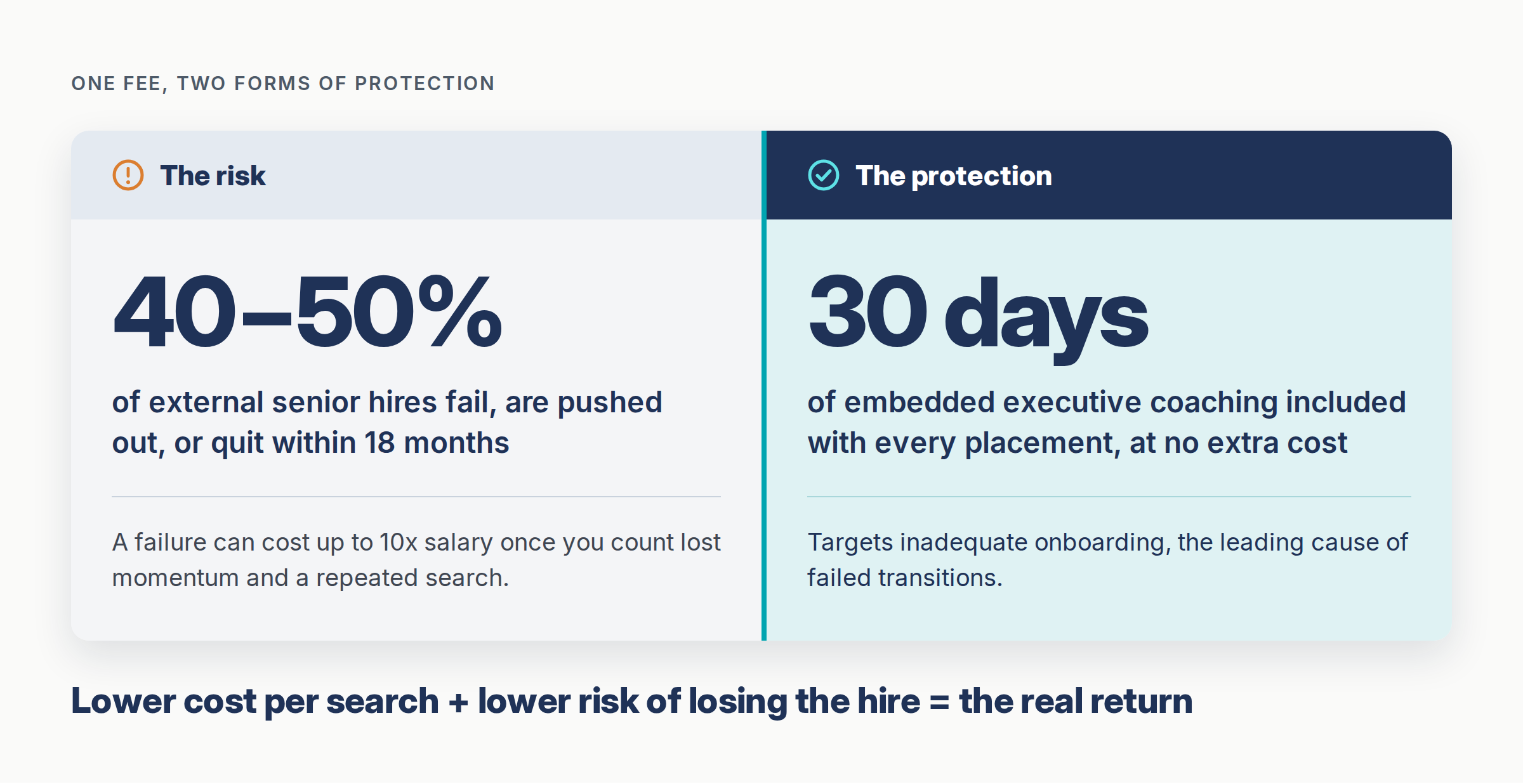
Getting the right person into the role is only half the job. Between 40% and 50% of externally hired senior executives are pushed out, fail, or quit within 18 months, according to Heidrick & Struggles and the Corporate Executive Board. Each failure can cost up to ten times the executive's salary once you count lost momentum, a disengaged team, and the search you now have to run again.
The reason is rarely competence. It's integration. A new leader doesn't yet know how decisions really get made, hasn't built trust with a team that's watching closely, and is left to read the culture and politics alone.
Inadequate onboarding is cited in roughly 45% of failed executive transitions. It's preventable, and most search firms walk away the moment the offer letter is signed.
That's why executive onboarding coaching is built into our model, not bolted on. Every VP-and-above placement includes 30 days of coaching. We use the same transition methodology we use with health system leaders navigating role changes, adapted for the highest-stakes month of a new executive's tenure.
A different model: retain a partner, not a fee structure
Empactful Partners built its retained executive search model for this environment. You pay a flat fee, not a percentage of compensation, and you work with a small senior team that learns your culture, strategy, and leadership bench.
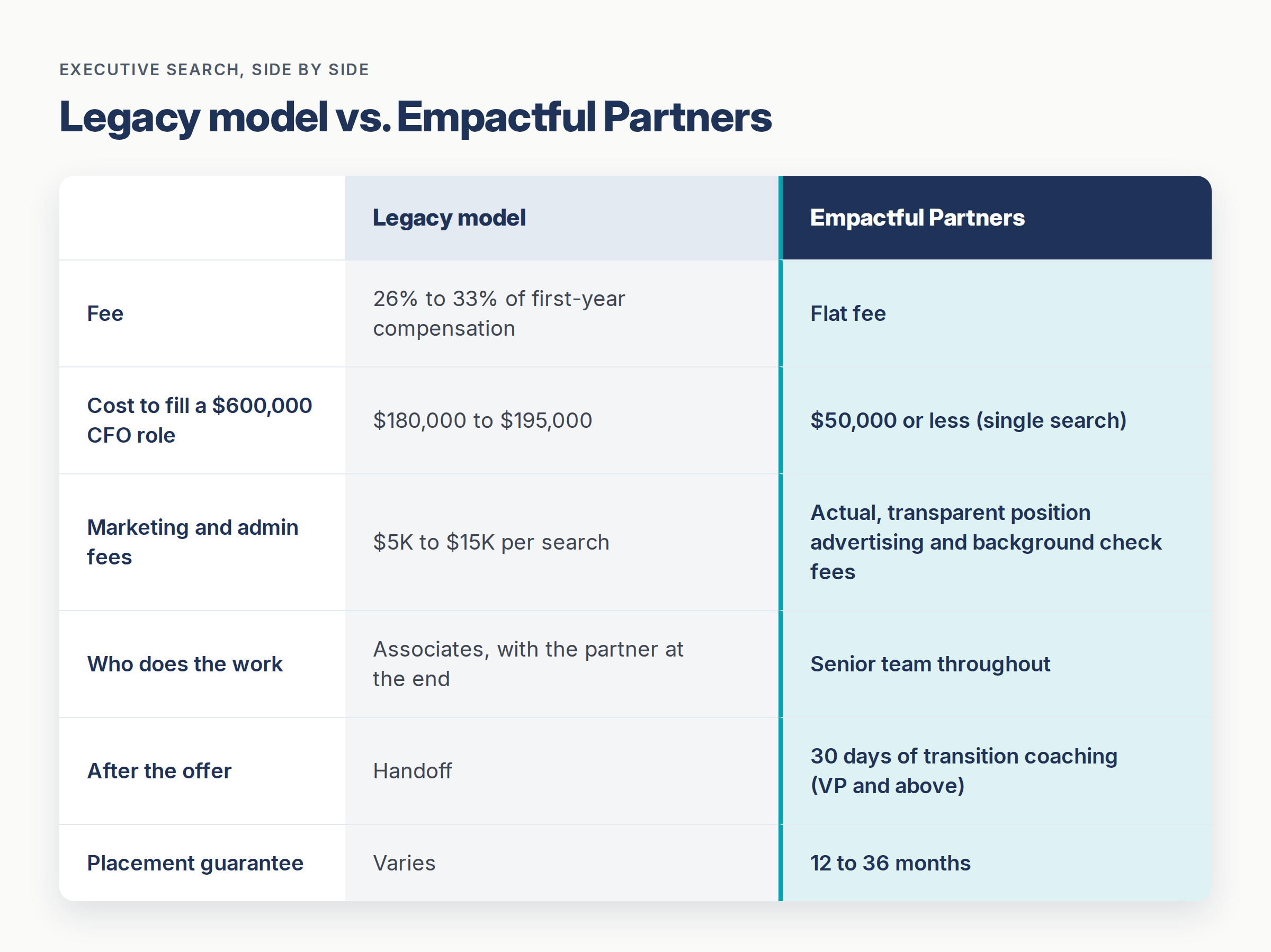
Choose the option that fits how often you hire:
- Single search: a flat fee of $50,000 or less.
- Annual partnership, 5 searches: $10,000 a month, about $24,000 per search.
- Annual partnership, 12 searches: $20,000 a month, about $20,000 per search.
Every option includes the concierge-level service and placement guarantees you'd expect from a top-tier firm, without a fee structure built to fund seven-figure partner incomes.
The clinical side of healthcare keeps changing. The business side should too.
Your organization has transformed care delivery, embraced value-based models, and rebuilt operations under relentless financial pressure. Retained executive search is one of the last corners of healthcare still priced like it's 1995. Change it.
Five C-suite searches at legacy rates: up to $990,000. On a flat-fee partnership: about $120,000.
What would you do with the difference back in your budget, and new leaders who stay? Start a search with Empactful Partners today.