
Best of Kin: How We Relate Determines How Well We Can Run
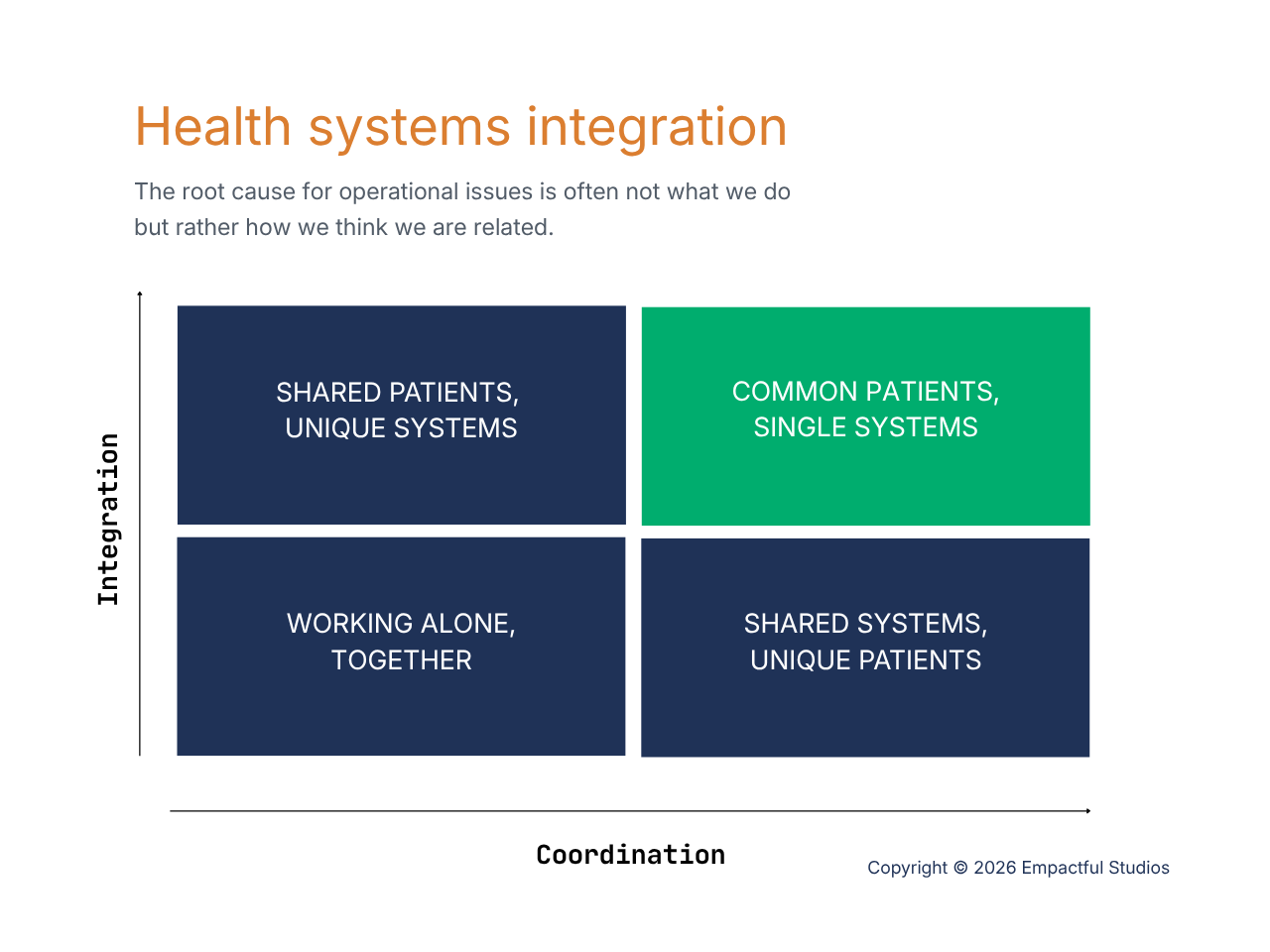
Most integrated health systems are still plagued by the reality of business lines working "alone, together" in one of two configurations.

Blended families are increasingly becoming the norm rather than the exception. While a beautiful expression of love, the family blend can be complex.
The same is true for integrated health systems. Most are a blend of hospitals, doctors, and ambulatory sites that come to the “family” with their own cultures, operating models, and organizational DNA. Assimilating those lines under a common brand often blurs some of the sharpest differences in legacy operating models. But is assimilation enough?
For integrated health systems, the evidence suggests not. Most integrated health systems are still plagued by the reality of business lines working "alone, together" in one of two configurations.
In the first, the health system appropriately views customers through the lens of the master brand, yet still channels them through a thicket of disjointed, often sub-branded operating systems disconnected from the family brand. This is frequently experienced as a station-to-station journey with repeat registration, disconnected scheduling, and disparate billing systems.
In the second, integrated networks leverage shared systems to take the seams out of patient navigation. They operate with centralized scheduling, registration, and billing platforms. Yet, internal, clinical lines persist in competing with one another for business and resources.
In both cases, the perceptual promise of a system whole that exceeds the sum of the integrated parts is exposed as little more than increased overhead and added complexity that adds no new value to the customer. In both cases, the root cause is not suboptimal operating performance within the lines but rather parochialism across the lines.
In short, the aggregated pieces and parts may all share the same surname, but from a customer point of view, act like anything but best of kin.
Self-assessment
How does your system perform? Consider the two-by-two grid and decide which of the four boxes best describes your enterprise's culture.
To guide that assessment, consider the signs of an organization that is still in the lower-left quadrant of working "alone, together:"
- System leadership meetings are highly tactical, not about what makes us distinctive
- Our marketing communications sound like our competitors’ claims
- The leadership team frequently talks about the risk of cannibalizing hospital business
- Our strategic priority is stated as market share, not meeting customer needs and aspirations
- System IT teams have disproportionate influence over how fast we get products to market
Consider leaders and management in your organization. Most health systems presume that their managers are leaders, either because the role confers that authority or because leadership is seen as a precursor to a management role. That assumption is not only false, but it ignores the reality that managers and leaders have unique roles in leading organizations from the lower-left quadrant of working "alone-together" to the upper-right quadrant of performing as a highly reliable, distinctive system of care.
In his Harvard Business Review article, What Leaders Really Do, John Kotter contrasts the unique roles of management and leadership. His distinctions are critical:
Management
- Planning and budgeting
- Organizing and staffing
- Control and problem-solving
Leadership
- Setting direction
- Aligning people
- Providing motivation
Assess your senior leadership team
- Is it clear to the people around the table whether they are expected to be managers or leaders?
- Is the team agenda organized around management purposes (we plan, budget, organize, and staff), or leadership goals (we set direction, align, and motivate people)?
Answering these foundational questions provides critical insight into changes you need to make to move your organization from the underperforming lower-left quadrant to the market-driving upper right.



Comments ()